Monday, December 04, 2006

Synchronization of Traffic Signals is more important than acquisition of Speed Guns


It seems Navi Mumbai cops are perturbed due to vehicles speeding (beyond permissible limits of 60KMPH) on Palm Beach Road.


There are five traffic signals installed (between Belapur and Vashi) on the Palm Beach Road. Another couple of traffic signals may be required to be installed in near future. No big deal, one has to deal with traffic signals.


The problem is that the signals do not appear to be synchronized. All these five signals need to be synchronized. Once these signals are synchronized, the fact that they work in synch needs to be forcefully advertised so that all the motorists using the Palm Beach road are made aware of it. Moreover, the information regarding the required road speed to ensure a clear passage through all the five signals will also be needed to be effectively disseminated so that all the drivers are made fully aware of the futility of unnecessary speeding.

Believe me; once the above mentioned suggestions are effected, almost immediately, reduction of cases of speeding as well as accidents (on Palm Beach Highway) will become evident.


Post script:
Will anyone enlighten me - whether the Town Planners had factored the development of plots adjacent to Palm Beach road while planning the Palm Beach Road as a high speed corridor?

In foreseeable future, when all the projects adjacent to Palm Beach Road are complete and occupied, there will be only one way to ensure that Palm Beach Road remains a high speed corridor and doesn’t get transformed into a crowded (and polluted) gully – provision of a service road running along the Palm Beach road from Moraj Residency to Sector 48.

Forget about the maximum speed limit, what is required is minimum speed limit.

Happened to read an article regarding vehicles speeding (over the permissible limits) on roads. The main thrust of the article was toward enhancement of fine / penalty to be levied on violators. The logic being that it may improve compliance (of speed limits) and act as an effective deterrent (against speeding).

Very true indeed; I fully agree with this line of thinking as far as compliance and deterrence are concerned, but the article betrays a complete lack of understanding of the basic issue, i.e, the logic behind limiting traffic speeds; and this is what got my goat.

Traffic speed needs to be limited and it must be limited not only on the higher side but also on the lower side. The basic reason for placing a maximum speed limit is for the sake of safety related issues and the basic need for placing a minimum speed limit is to ensure that the traffic flow remains smooth and also to maintain the vehicle carrying capacity of a particular road.

The problem with our countrymen in general and policymakers and law enforcement agencies in particular is that they do not seem to believe in the dictum of application of mind. Their actions (and lack of action) appear to make it fully evident that they are blissfully ignorant about the fact that in this world everything is in a state of flux. To ensure that the policy remains in consonance with the ever-changing situation, the policy has to perforce keep evolving.

Coming back to the point – I, for one do not believe that there is even an iota of logic behind the maximum speed of 40 KMPH for heavy vehicles and 50 or 60 KMPH for other vehicles that is mandated by the existing laws. These speed limits were put in place in the bygone era when the vehicle technology was severely limited, atleast as far as mass produced vehicles were concerned. People who have been driving for more than thirty years will be able to remember the handling limits and quirks of cars like Ambassador and will also be able to appreciate the difference between cars like those and the current generation cars. Similar is the case when one compares an old generation truck and the latest ones. The whole gamut of technologies has evolved – tyres are much better, braking is surer, suspension technology has improved resulting in much better road holding and vehicle handling; engines have become much more powerful as well as efficient and the shape of the automobile has evolved to such an extent that coefficient of drag has reduced by a significant quantum. All these developments have eroded the logic behind the speed limits of 40 – 60 KMPH.

In fact, the technological advancements have been so profound that they have rendered the existing speed limits as nothing but a big joke. There can be no doubt that the maximum speed limits as they exist in the statute are nothing but anachronism. These limits need to be revised and experts in the field of traffic management / road safety / automobile associations must be consulted before arriving at any decision.

Another pertinent point is traffic congestion related woes. In this context, it is imperative that a minimum speed limit regime is brought forth. What this will do is that it will reduce the road occupancy time per vehicle unit and will in turn ensure the maintenance of road capacity. It is simple, the higher the speed of traffic the greater the roads’ traffic carrying capacity. And it is nothing new or path-breaking, it has been in vogue for decades in the developed world.


Post script (in lighter vein)-

In case legal maximum speed are not raised, hundred percent compliance can definitely be ensured by making it mandatory for all the vehicles running on Indian roads to be fitted with a “speed governor” so that the maximum speed of vehicles is limited to 60KMPH. In this era of Electronic Controls, it will just require tweaking of the ECU programmes. Well bullock carts may not need the “speed governor” and plying bullock carts will reduce dependence on Crude Imports and will save valuable foreign exchange. Indian Oil, ONGC, RIL may get engaged in developing better and cheaper feeds for bullocks. Once bullock cart traffic takes primacy, there will be a case for reducing the maximum permissible speed to – say- 5 KMPH so that no one puts undue physical strain on bullocks by making them go faster and no one foolish enough to drive an automobile hits a bullock cart. Way to go!!!!

Monday, November 06, 2006

Should the media compell Ram Jethmalani to obtain its opinion before taking up a brief?

Ram Jethmalani, the celebrated lawyer has taken up the brief to defend Manu Sharma who is alleged to have shot dead the model cum bartender Jessica Lal.

Next we find that there is allround criticism against Ram Jethmalani – because he decided to mount an effective defence in favour of the alleged killer. Some reports appearing in media suggested that even his immediate family members (largely comprising of legal practistioners) were also dead against him.

Lots of people have been expressing their opinion on the issue – the undertone being that it is wrong on the part of the celebrated lawyer to have come to the defence of Manu Sharma. Off course there have been some who have tried to see the issue in a proper light. But there have been others who have been spectacularly articulate in mounting a particularly virulent criticism.

This issue throws up some interesting but disturbing questions.

First and foremost does this brouhaha mean that Manu Sharma does not have a right to have a defence lawyer?

Secondly, what would have happned if, instead of Ram Jethmalani the celebrated lawyer, an obscure advocate had taken up the brief? Do you think that the media would have propelled such an obscure personality to the headlines of almost all the leading dailies in the country? Does this mean that just because Ram Jethmalani happens to be Ram Jethmalani, certain cases should be beyond his domain? Or to rephrase it, would it mean that heinous crimes which catch the attention of media should remain beyond the pale of celebrated lawyers – that celebrated lawyers should not appear in such cases as defence lawyers. Or that the media should decide which lawyer should defend which accused and in what manner.


Thirdly, why does the media feel or propagate the feeling that the prosecution is the underdog whereas it should be the other way round? No doubt too many infirmities get introduced in cases made out by the prosecution but most of that has its origin in shoddy investigation skills of a poorly paid and plainly incompetent police force. Now please do not get me wrong, our police force may be quite good at putting up a show in the honour of so called VIPs and may also be sufficiently competent in managing law and order related issues but when it comes to hardcore investigation they do draw a blank more often than not. This is a cultural and historical problem and can be overcome only when deep rooted reforms are initiated (read my earlier posts on the subject).

Well the matter does not end with the conviction of one Santosh Singh. It may not end even if the likes of Manu Sharmas and Vikas Yadavs are also convicted. It may not have any effect even if people like the Sanjeev Nanda manage to effectively buy their way out of jail.


What all this means is that the cases which get the attention of the popular media may get better treatment at the hands of the police and prosecution; but then, if the basic competence of police and prosecution itself is suspect then even after all the attention the cases may fail.

Now to blame the celebrated defence lawyer is akin to barking up the wrong tree.

Saturday, October 21, 2006

Exploring our country on a motorbike - Michael Soier and his 800 cc Suzuki

Met an interesting character, one Mr. Michael Soier a motorbiking enthusiast.
This gentleman has been riding across some of the most challenging terrains in the world on an 800cc single cylinder Suzuki Motorbike. Some of his pictures taken on 20.10.2006 are shown below.


His spills and spoils can be followed on his website.
He has planned to spend the next couple of months exploring our country. To begin with he will be riding down south to Kerala and thereafter will be traveling to the northern and northeastern part of the country.

Friday, October 13, 2006

Update on begging by children

SMSs are puprotedly being sent by the Commissioner of Labour (State of Maharashtra) to Airtel Phones. One such SMS (received on 14.10.2006) reads- “Ban on engaging child as domestic servant or hotel, tea shops, dhabas, eating houses, spas etc. Request you not to employ child below fourteen years and help us to make our state child labour free”.

Looks like soon we will start getting SMSs advising us to refrain from giving alms to children engaged in begging. Let us hope, we the people start taking such advices (if and when they are sent) seriously.


Post Script
Next, in these liberalized times the syndicates engaged in the business of utilizing the services of children for the profitable business of begging may start an agitation. Perhaps such an agitation may find support from the groups engaged in the peripheral activities viz., kidnapping of children, physically mutilating such children (it increases the market value of such child beggars).

"Child Labour Banned"- "Begging By Children Allowed"

The Central Legislation banning children (below the age of 14 years) from working in hazardous conditions (which perhaps doesn't include begging by small children in crowded local trains) came into effect from 10th October 2006.
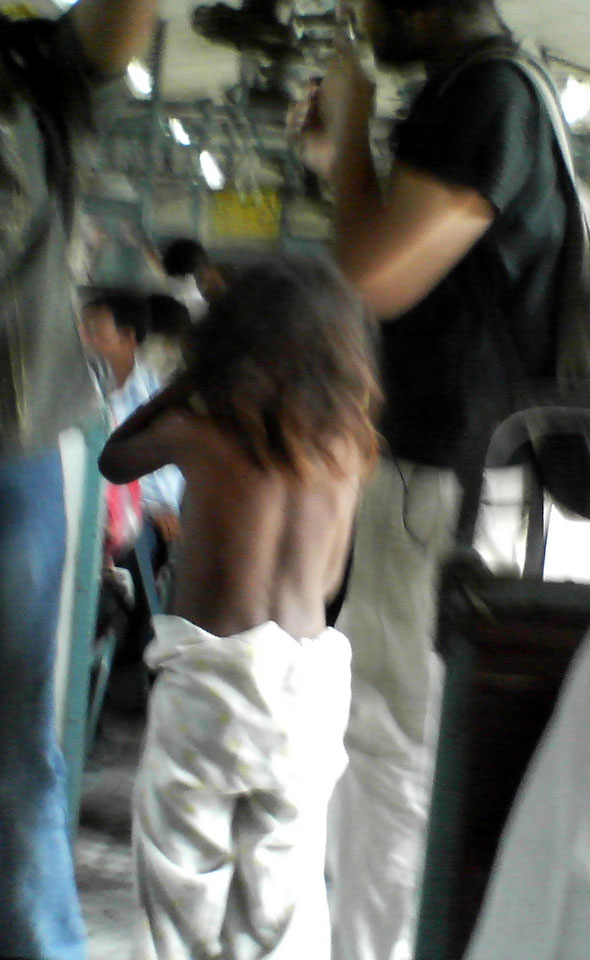
In theory this ban is definitely a step in the right direction but there is disturbing dissonance between the quixotic laws conceived by our myopic policymakers, enforced (rather not enforced) by our creaking law enforcement mechanism and the ground realities that obtain in our fast developing(?) country. The photographs appearing below will eloquently attest to that disturbing conflict.

The girl child appearing in the photos, as can be seen was partially clad and was begging in a local train in the suburbs of Mumbai –The Financial Capital of India. She could not have been more than five or six year old.

The question is - will the ban on child labour have any effect on this phenomenon where small children are either forced to beg due to abject poverty or due to the criminal avarice of entrenched gangs engaged in such shameless business where destitute children are not only forced to beg but are also subjected to all kind of abuses and physical mutilation. This can end only when the Government and Society take responsibility of welfare of such children and ensure that scandals in juvenile homes and child care institutes become history.

The economy is booming, India is shining but the naked underbelly is showing.


Formulate legislation to regulate begging and allow beggars to form legally valid unions / associations. This move will certainly certify the Indian State as a failed welfare state but the consolation will be that beggars will have a platform to voice their concerns. I hope that this move will not adversely impinge on the growth rate of Indian Economy. Atleast India will remain shining.

Tuesday, October 10, 2006

Chief Minister is the King - How come a banal issue regarding non-payment of bill, result in disconnection of power supply to his residence?

My attention was drawn on news about “Power Snap At CM’s House” which was published in the Times of India, Mumbai Edition (TIMES CITY section) page 3 (10.10.2006) - "Notices served on two senior bureaucrats".

The background of the case is as follows: on September 11, 2006, MSEDCL had disconnected the power (electricity) supply to the Maharashtra Chief Minister’s official residence (Ramgiri) at Nagpur as there was a huge outstanding amount ( perhaps more than Rs. 1 lac) which the Government of Maharashtra or PWD had purportedly failed to pay despite several reminders. This matter was lapped up by the media and it seems it resulted in considerable embarrassment to the State Government. The Chief Minister was outraged at the audacity of MSEDCL and understandably, the State Government’s immediate knee-jerk reaction was to suspend the concerned Superintending Engineer. But more embarrassment was in store - due to widespread agitation by the MSEDCL staff, the suspension had to be revoked. Another embarrassing incident!!

Now, it seems that the Government in all its considerable wisdom (?) is trying to fix responsibility on two senior bureaucrats who happen to be at the helms of the affair at MSEDCL. I, personally do not have any idea about the competence or lack of competence of the two senior bureaucrats who have been served with notices but my curiosity is certainly aroused by the fact that till date I have not come across any news about attempt at fixing the responsibility of the shenanigans on the Government Department concerned with making the payment of the electricity bills. This is curious. The fundamental fault is there for all to see but no action seems to have been taken on that front to ensure that such mistakes do not recur. Or perhaps, the State Government feels that there was no mistake on its part if the bills were not paid, or that the bills should not have been raised at all, as it concerned the Chief Minister’s Residence.

Far from being a cause for embarrassment, this issue of disconnection of power supply could have been handled in a much better manner if the P.R. machinery of the State Government had been blessed with people with the right aptitude and attitude. In fact, the State government should have initiated actions to resolve the issue related to non payment of bills and should have appreciated the MSEDCL’s action by suggesting that it had done the right thing. This one act would have reinforced the idea that the law of the land is equally applicable to all and sundry. This course of action would have saved the Government the blushes and would have given much needed fillip to the beleaguered MSEDCL which is struggling with arrears. It would have also sent the right signals to all the consumers of electricity.

Post Script:
Even otherwise, it is high time for the Chief Ministers of Indian States (as well as other potentates ranging from politicians to bureaucrats, blessed with official authority) to get out of the warped belief that they are de-facto kings and satraps (from the medieval era) and hence above the law. The sooner this happens, the better it would be to the cause of democracy.

Saturday, October 07, 2006

Power Shortage - major stumbling block in the process of economic growth

Once upon a time there were no cell phones. Public Sector / Government enterprises like MTNL and DOT were the only telephony service providers in India.

In those days the long distance calling charges were sky high and local call charges were unrealistically low (no call duration limits). The interesting part was that once a consumer crossed a particular threshold in terms of number of calls being made during a particular billing cycle, he was charged at higher rate / slab. In other words, consumers with high usage were charged at a higher rate (i.e, per call unit) than consumers with low usage. This distortion naturally resulted in many consumers opting for multiple phone connections, so that they could manage to keep the number of calls per phone below the crucial threshold.

Now look at the situation- the theory behind small consumers being charged less was ostensibly to subsidize their cost of phone usage and to encourage more people to opt for phones - greater and wider penetration. But this resulted in more phone connections being garnered by big consumers; and this was in the days when there used to be a considerable waiting period for getting a phone connection.

Well the situation changed drastically when the telecom sector came to be liberalized; so much so that the same Public Sector Enterprises are now giving the private players a run for their money when it comes to tariff and consumer friendly schemes.
Similar situation has emerged in the power sector. Just look at the latest fiat from MERC- it envisages penalty on consumers who consume more than a specified limit (both in absolute terms of 300 units per month as well as dependent on individual consumers’ past consumption pattern). Now, this kind of convoluted thinking is not only draconian, especially in these liberalized times, but also potentially dangerous for the economy. Why dangerous – just calculate the power consumption pattern of a typical Mumbai Apartment Dweller- if he uses a couple of ACs (falling prices have made it more of a necessity than luxury in the humid climate of Mumbai) and some other time saving and labour saving gadgets like Washing Machine and Microwave Oven / Toasters etc., his / her electricity consumption is bound to cross the threshold of 300 units (it will be closer to 500 units). Even otherwise in a developing economy, limiting power consumption based on historical consumption pattern does not make any sense – per capita power consumption in India is very low and as the economy grows, it is bound to go up- it is a healthy sign.

Penalising consumers for higher power consumption may have cascading effect on almost all the
white goods manufacturers and may even have a palpable impact on the economic growth. Instead of penalizing consumers who consume more electricity, for ameliorating the grim situation in the short term, the whole gamut of pricing process should be rationalized and this rationalization should compulsorily include reduction of wastage (pilferage camouflaged as T&D losses and actual T&D losses much beyond international norms). There is bound to be a lot of scope for improving efficiency and cost reduction in the whole business of electricity generation, transmission and distribution.

As far as long term / medium term measure is concerned, there is need for setting up of large power stations and a policy to see that the large coal reserves and natural gas reserves are utilized for electricity generation. The pace of liberalization and reforms in power sector must speed up immediately or else power scarcity may become a major stumbling block in the process of economic growth.

Reality of infrastructure (roads)


What you see in this photo is not a scene from bombed out Iraq or Afghanistan or for that matter from any of the BIMARU states. This is straight from the road / bridge which serves the busiest Indian International Port Terminals clustered around JNPT. This particular bridge connects all (bar one) Container Freight Stations with the Port area. It is heavily trafficked day in day out, 24/7. The amount of money (fuel wastage, increased vehicle maintenance costs and time lost) going down the drain may be colossal but who cares.

The only hope is that someday someone may file a PIL and then the judiciary may compel better maintenance, till then enjoy the potholes and the bumpy and jerky ride.


Another point, our esteemed infrastructure planners could not envisage that there should have been grade separation at places where there are intersections. Especially, when in all their wisdom, they planned to have almost all the Container Freight Stations at a location which entails two road intersections and two rail intersections. Small mercy that the rail intersections do have grade separation but there is no grade separation at two vital points where there are intersecting roads. At the first intersection (at Sonari Chowky), one invariably comes across a traffic jam. It is only the efficiency of the traffic constables (poor souls – forced to withstand so much pollution) that saves the day.


It is interesting to note that the proposed SEZ is also coming up in the same general area.


Wednesday, October 04, 2006

Water - a precious commodity?


Water crisis may be more of a case of mismanagement, wastage and skewed availability / distribution than shortage, but the resultant picture is certainly not pretty.

As the old adage goes, “a picture is worth thousand words.”

But the question is how to rectify situations and circumstances which lead to such pictures becoming commonplace. This particular picture was not shot in any backward, underdeveloped region of the country but in close proximity to the nation’s most modern and biggest cluster of International Port Terminals. The direness of situation in other areas which are not blessed with either the proximity to power centres (financial, political, economical) or abundant rainfall can only be imagined.

Or else, ponder over the other old adage - "Water everywhere, but not a drop to drink"